
Gadenstätter, Clemens
* 1966
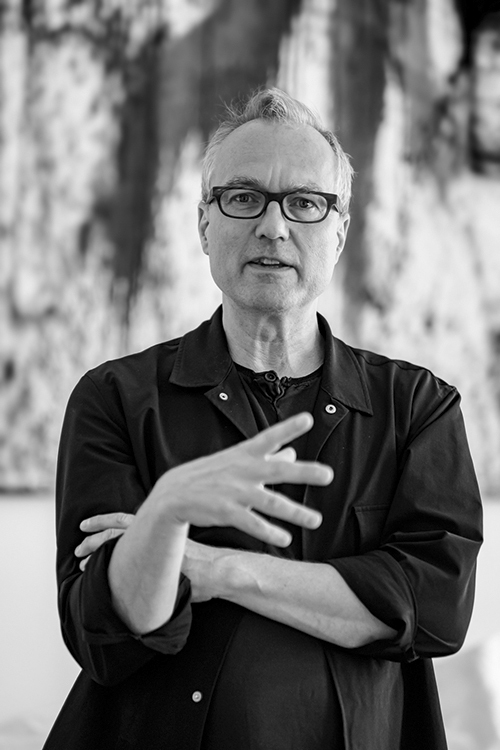
Born in 1966 in Zell am See, Austria, Clemens Gadenstätter studied composition with Erich Urbanner and Helmut Lachenmann. He is regarded as one of the composers of his generation who, perhaps more than most, probe the very substance of music. At the core of his work lies not the material itself nor its critical reflection, but a philosophy of listening, understanding, and sensing. This philosophy is grounded in semantic analysis and an in-depth engagement with phenomena of perception.
Gadenstätter’s thinking follows a dual approach: on the one hand, his essays describe models of sonic perception and their structuring; on the other, this reflection is mirrored within the sounding work itself. His texts are far more than ancillary material—they unfold autonomous theoretical models that are effective and applicable beyond his music alone.
Over the course of his compositional and theoretical work, the question of how listening functions as a bodily and semantic process has increasingly moved to the center. His pieces are not mere applications of concepts formulated in advance, but integral components of a mode of thinking that takes place through artistic practice. They render his philosophy audible.
Gadenstätter’s compositions often draw on the simplest source material—sonic or non-sonic: from everyday noises and bodily sensations to complex layers of meaning. This material is analyzed, categorized, transformed, and transferred into new musical contexts. In listening, a process of semantic displacement unfolds, in which the familiar becomes strange and the banal gains depth. Listening, in Gadenstätter’s work, becomes a conscious act—an act of understanding that is semantic, sensory, and bodily at once.
In Semantical Investigations, he explores banal everyday sounds and their universes of meaning. The work series E.P.O.S.: les premiers cris, les cris des lumières, les derniers cris for various ensemble configurations engages with the transformation of acoustically triggered, pre-formed sensations. SAD SONGS likewise addresses human emotions. In ICONOSONICS, Gadenstätter analyzes iconographic contexts through compositional means. His madrigals focus on elementary pre- and extra-linguistic forms of human expression. The exploration of meaning and perception runs throughout countless other works in his extensive oeuvre, as does his critical view of an increasingly isolating society.
In recent years, an intensified dialogue with other media has become apparent, as in les cris des lumières for ensemble and light, or daily transformations for voices, instruments, electronics, video, space, and light. His most recent works engage with the phenomenon of intimacy as a field of societal influence on subjectivity (making of – intimacy for flute and orchestra; BREAK EDEN – Songs for voice and keyboard; intimate construction for ensemble).
The essays HÖREN VERSTEHEN KOMPONIEREN and Was heißt hier banal, as well as a detailed biography and complete list of works, have been published and are also available on the composer’s website:
www.clemensgadenstaetter.eu
(Andreas Karl)
Works

Studies for imaginary portraits for recorder solo
for alto / tenor recorder
Purchase material4 studies for selfportraits in surroundings
for accordion and electronics
Purchase materialStudies for portraits in surroundings (with J.L.G. & P.B.)
for oboe and keyboard
Purchase material